November 16, 2026
Portable vs. Stationary Compressors: Which Setup Suits Your Operation?
By @practicalsitegear
Understanding the two main types of air compressors
When you need compressed air for your shop, job site, or industrial process, the first big decision is whether to go with a portable unit or a stationary system. Each has its strengths, and the right choice depends on how much air you use, how often, and where you need it. This article compares the two approaches and explains when a stationary screw compressor might be the better fit for higher-demand operations.
Portable compressors: flexibility and convenience
Portable compressors are designed to move. They come on wheels or have lifting points, and they can be towed or carried to wherever the work is. Most use reciprocating piston or scroll pumps, though some smaller screw compressors are also built on skids for transport. Their main advantage is that you can take the air supply to the job rather than running long hoses or pipes from a fixed plant.
Typical portable units have a receiver tank that stores compressed air, allowing the motor to cycle on and off as air demand changes. This works well for intermittent tasks like inflating tires, running nail guns, or powering impact wrenches on a construction site. The duty cycle of a portable compressor is usually lower than a stationary model, meaning it needs rest periods between running to avoid overheating. For light to moderate use, that is perfectly fine.
Portable compressors also tend to be less expensive upfront. They are a common entry point for small workshops, mobile mechanics, and contractors who need air at multiple locations. The trade-off comes when air demand is continuous or high volume. A portable unit may struggle to maintain operating pressure if you run several pneumatic tools at once or if the duty cycle is pushed beyond its design limits. Pressure drop across long hoses can also become a problem, forcing the compressor to run longer and hotter.
Stationary compressors: power and continuous duty
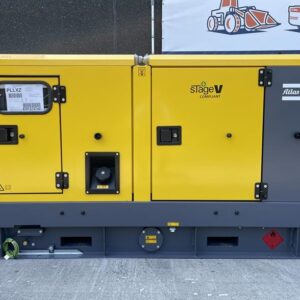
Stationary compressors are built to stay in one place and deliver a steady, high-volume air supply. They are typically larger, heavier, and bolted to a concrete pad or structural frame. Many use a screw compressor element, which is a rotary positive-displacement design that moves air continuously with very little pulsation. Screw compressors are known for high efficiency at full load and the ability to run for extended periods without overheating.
Because they are stationary, you can install them with proper intake and exhaust ducting, a dedicated electrical supply, and a larger receiver tank or air dryer system. The result is a reliable source of compressed air that can feed multiple workstations, automated machinery, or a whole factory. The airflow rate from a stationary screw compressor is typically much higher than what a portable unit can deliver, and the operating pressure can be maintained within a tight band even as tools cycle on and off.
Stationary systems also allow for better control of pressure drop. You can run properly sized steel or copper pipe to each point of use, with branch lines that match the demand. This reduces waste and keeps the compressor from short-cycling. Over time, the energy savings from a well-designed stationary system can offset the higher initial investment, especially in operations that run compressed air for several shifts a day.
Comparing the two setups
Air demand and duty cycle
The most important factor is how much air you need and for how long. If your work involves short bursts of air followed by long idle periods, a portable compressor with a decent receiver tank will serve you well. If you run pneumatic tools continuously, or if you have multiple operators drawing air at the same time, you need a stationary system that can handle a 100% duty cycle. A screw compressor is particularly suited to this because it does not rely on the start-stop cycling of a piston pump; it modulates its output to match demand.
Mobility
If your work moves from site to site, portability is non-negotiable. A towable or skid-mounted compressor lets you bring air to where it is needed. But if you have a fixed workshop or production line, stationary installation frees up floor space and reduces the risk of damage from moving equipment. It also makes maintenance easier because the compressor is always in the same spot and can be serviced without disconnecting it from the pipework.
Operating pressure and airflow
Portable compressors often have a maximum operating pressure of around 150 psi, which is enough for most construction tools. Stationary screw compressors can be configured for higher pressures and much larger airflow rates. If your application requires a sustained flow of 50 cfm or more, or if you need to maintain pressure while multiple tools run simultaneously, a stationary system is the practical choice.
Noise and environment
Portable compressors are often louder because they have less soundproofing and are placed closer to the work. Stationary compressors can be housed in a separate room or enclosure, which dramatically reduces noise in the workspace. This matters for employee comfort and for meeting workplace noise regulations.
Total cost of ownership
While portable units have a lower purchase price, they may need replacement sooner if run hard. Stationary screw compressors, when properly maintained, can last many years and deliver lower cost per cubic foot of air. They also let you add filtration, dryers, and receivers to improve air quality, which protects your tools and products. For operations that rely heavily on compressed air, the stationary system often pays for itself over time.
When a stationary screw compressor makes sense
A stationary screw compressor is the right choice when your air demand is continuous or high, when you need to run multiple tools or machines at once, and when you have a fixed location where the compressor can be installed. Industries such as automotive repair, metal fabrication, woodworking, and food processing often find that a screw compressor meets their needs for a steady, clean air supply. It is also a good fit for any operation that uses pneumatic tools for more than half the workday, or that requires a receiver tank large enough to buffer against peaks in demand.
One more point worth considering is the ease of expanding a stationary system. If you add new workstations later, you can extend the pipework and possibly increase the receiver tank size. With a portable unit, you are limited by its single output and its duty cycle. A well-designed stationary setup grows with your operation.
If you are evaluating equipment for your facility, you can explore the range of stationary screw compressors available through marketplaces such as ePowerhouse LLC. Their selection includes units suited for different airflow rates and operating pressures, and their product pages provide detailed specs to help you compare. Keep in mind that the compressor itself is only part of the system: you will also need proper piping, filtration, and possibly an air dryer to get the best performance. A qualified installer can help you size the components correctly for your specific air demand and pressure drop requirements.
Making your choice
Start by listing your current and future air needs. Estimate the total airflow you use at peak times, and how long those peaks last. If the numbers point to a duty cycle above 60% or a flow rate that pushes a portable unit to its limit, a stationary screw compressor is likely the better long-term investment. For lighter, intermittent use, a portable compressor offers flexibility at a lower upfront cost.
There is no single right answer for every shop. The best setup is the one that matches your actual work patterns and your budget for both purchase and operation. Understanding the trade-offs between portability and continuous power will help you avoid buying a system that is either too small to get the job done or too large and expensive for your needs.
Whether you choose a portable unit or a stationary screw compressor, make sure to factor in the cost of installation, maintenance, and energy. A compressor that is properly sized and installed will serve your operation reliably for years. For those who need a high-volume, continuous-duty solution, the stationary screw compressor remains a proven workhorse in industrial settings. And for those who value mobility, the portable compressor remains a versatile tool that puts air where the work is. Both have their place, and knowing the difference helps you spend wisely.
❧